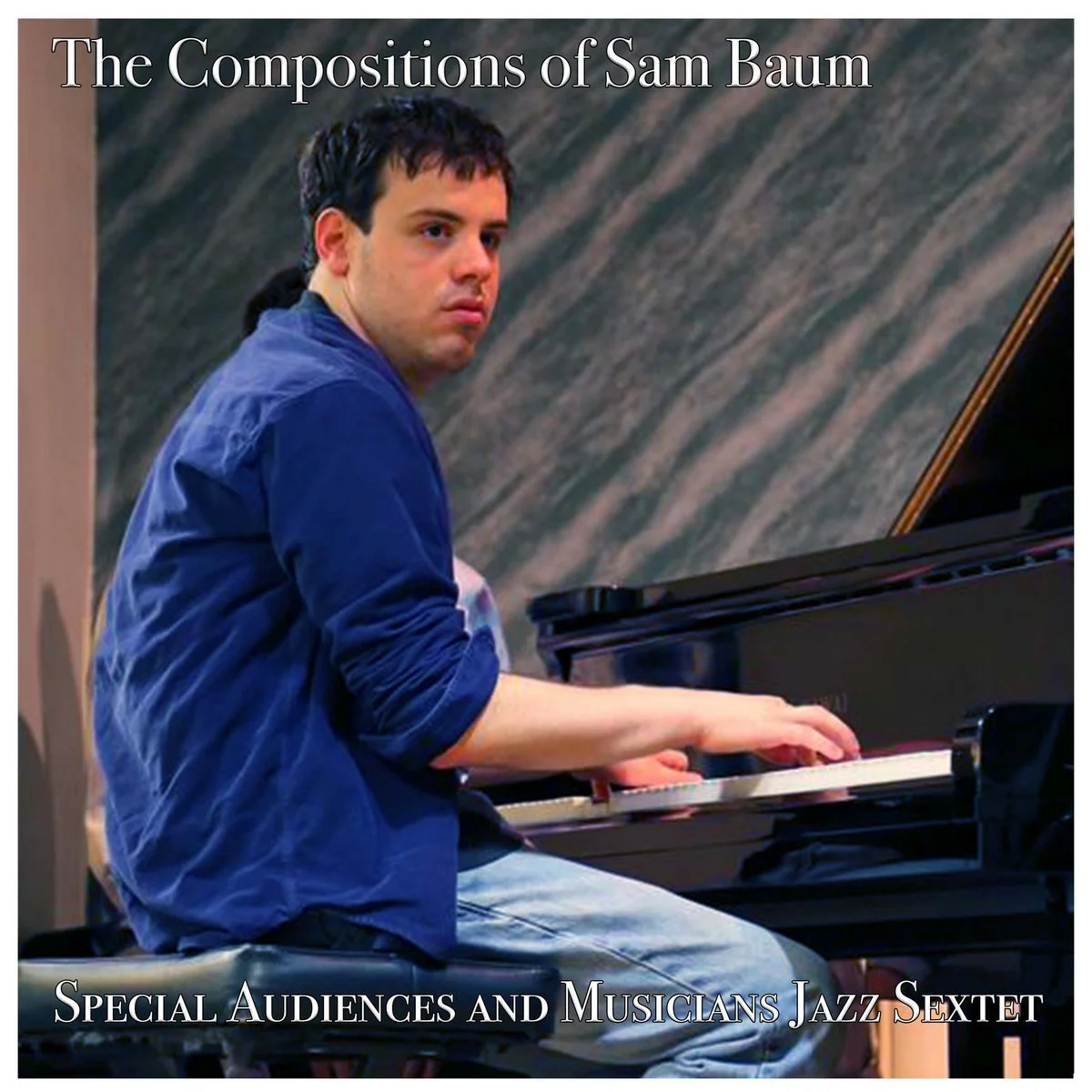
Review by Scott Yanow
Special Audiences and Musicians (SAM) was created in 2017 with two purposes. It puts on jazz concerts at nursing homes, assisted living institutions, hospitals, and other institutions. And it provides playing opportunities for musicians from three under-represented groups: senior musicians, women and especially those with disabilities.
The Special Audiences and Musicians Jazz Sextet on their debut recording performs 11 pieces by pianist Sam Baum. The group for the session consists of Baum (who is autistic), trumpeter Angeleisha Rodgers, saxophonist Itamar Shatz, Noe Socha (who is blind) on guitar and harmonica, the late Murray Wall on bass, and drummer David Segal (who has a muscular/neurological condition).
While it is fair to say that none of the musicians are virtuosos, it is remarkable how well they do play at times. The 11 Baum pieces include two medium-tempo blues, several songs based on the chord changes of “I Got Rhythm,” a tune apiece that is similar in its chord structure to “Satin Doll” and “The Devil And The Deep Blue Sea” (which here is called “Swimming In The Wide Blue Water”), a jazz waltz, and the best melody of the set “Seven Children.” “Weekly Evening Park” has a particularly playful question and answer melody. Of the musicians, Sam Baum comes up with plenty of fresh ideas, Angeleisha Rodgers contributes an expressive scat-filled vocal on “Sam’s New York,” and guitarist Noe Socha is the best all-round soloist.
SAM is a very worthy organization well worth supporting. More information can be found at www.specialaudiencesandmusicians.org.
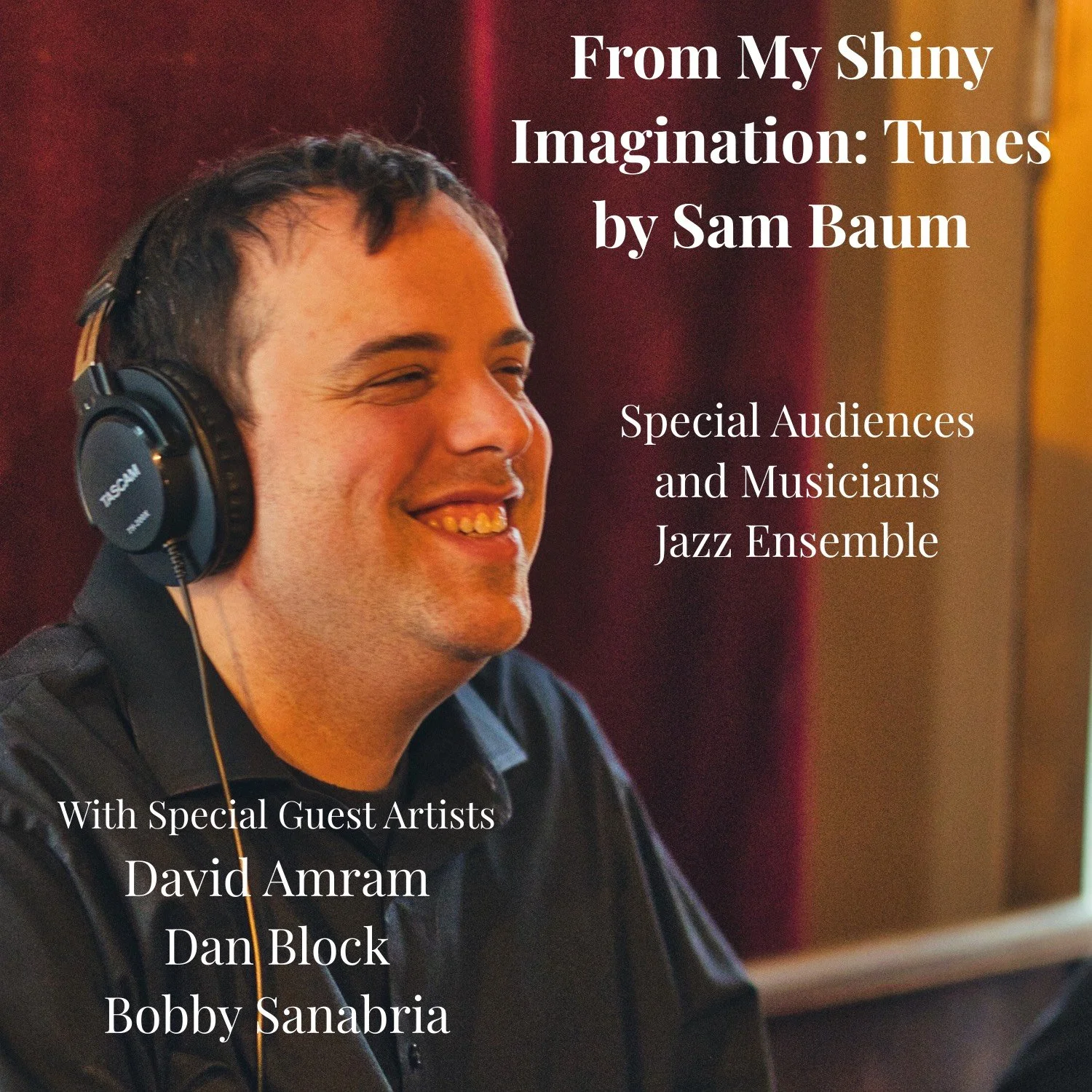
Press Release 2026
SPECIAL AUDIENCES AND MUSICIANS (SAM) TO RELEASE FROM MY SHINY IMAGINATION, A NEW ALBUM PRESENTING A COMPLETE PROGRAM OF ORIGINAL COMPOSITIONS BY PIANIST & COMPOSER SAM BAUM
RECORDED WITH THE SPECIAL AUDIENCES AND MUSICIANS JAZZ ENSEMBLE FEATURING LEV GARFEIN, SARAH TURKIEW, TONY VENTURA, NOE SOCHA & BRAULIO THORNE
WITH SPECIAL GUEST APPEARANCES BY
DAN BLOCK, BOBBY SANABRIA & DAVID AMRAM
AVAILABLE APRIL 2026 IN CONJUNCTION WITH WORLD AUTISM AWARENESS DAY VIA SPECIAL AUDIENCES AND MUSICIANS (SAM)
“Special Audiences and Musicians spreads the musical gifts of challenged musicians by bringing live jazz to institutions where their music is deeply appreciated and can have a therapeutic effect on performers and audiences alike.
SAM gives these gifted players meaningful performance opportunities and supports a rewarding life of service to one another and to their listeners.
It’s a win-win organization, worthy of all the support it can receive. Go, Sam!”
—Fred Hersch, 17-time Grammy-nominated pianist
From My Shiny Imagination: Music by Sam Baum is the forthcoming album by pianist and composer Sam Baum, to be released in April 2026 in conjunction with World Autism Awareness Day. Recorded January 4, 2026 at Old Soul Studio in Catskill, New York, the album presents a complete program of Baum’s original compositions.
The recording is closely connected to Special Audiences and Musicians (SAM), the New York–based nonprofit organization founded in 2017 by trumpeter and educator Jeffrey Nussbaum, Baum’s father, and dedicated to supporting jazz musicians with disabilities. Through SAM, Nussbaum has built working jazz ensembles and presented performances in hospitals, senior centers, schools, residences for blind adults, and union venues across New York City and the surrounding region. Musicians are engaged on a paid, professional basis, with many performances contracted through the American Federation of Musicians’ Local 802.
The music on From My Shiny Imagination is performed by the Special Audiences and Musicians Jazz Ensemble, with Baum on piano alongside violinist Lev Garfein, baritone saxophonist Sarah Turkiew, bassist Tony Ventura, guitarist and harmonica player Noe Socha, and conga player Braulio Thorne. Three guest artists appear on the session: Dan Block, a Juilliard-trained clarinetist and saxophonist who served as musical director; Bobby Sanabria, a Berklee-trained drummer, bandleader, and educator; and composer and multi-instrumentalist David Amram, who appears on penny whistle.
Several members of the ensemble bring long personal and professional histories to the project. Socha, blind since infancy, has long anchored the group’s sound. “Noe has really big ears,” Nussbaum says. Turkiew, an autistic baritone saxophonist and composer, earns Nussbaum’s description as “a monster player.” Ventura, a New York–area bassist who contracted polio as a child, brings decades of experience as a working musician. Thorne, also blind, first sat in on congas through a SAM residency before joining the ensemble more formally. Garfein, who is on the autism spectrum, came to the project through pianist Fred Hersch’s circle.
Sanabria is explicit about the standard he brings to the project. “I don’t want people to look at this recording as some quirky kind of oddity,” he says. “I want it judged on its musical merits — good music, played by great musicians.”
“As instrumental musicians, we don’t have the luxury of lyrics,” Sanabria continues. “If a singer performs something like ‘Good Morning Heartache,’ you know immediately what it’s about. When you’re playing that feeling on an instrument, everything has to come through the sound.” He adds, “I’ve taught and worked with autistic musicians in schools and on bandstands, and I don’t lower the bar for anybody.”
Sanabria hears Baum’s writing within a longer musical continuum. “This music harkens back, melodically and harmonically, to another era — the ’30s and ’40s,” he says. “I hear Monk. I hear Horace Silver. In some of the Latin-oriented pieces, I hear Pérez Prado.”
Rehearsals are limited by design, a practice Nussbaum applies across SAM ensembles. “We tend to learn the material on the gig,” he says. “I feel the group learns it on a deeper level when the pressure is on.” He adds, “Jazz, ultimately, the highest goal is individual expression.”
Before founding SAM, Nussbaum spent more than three decades as a New York City special education teacher. He is also the founder of the Historic Brass Society, an international organization devoted to early brass music and historically informed performance, which he led for decades while producing scholarly journals, organizing conferences in the United States and Europe, and presenting performances at universities and cultural institutions.
Baum began playing jazz piano at age 13 and gravitated early toward improvisation and composition. He studied with teachers including Danny Mixon and Dan Kaufman. His music draws on jazz piano study, synagogue repertoire, Afro-Caribbean rhythms, blues, and swing. Many of the pieces are written for specific people and moments in his life, with titles he assigns immediately upon completing each composition. He arrives at sessions with completed works and a clear sense of form. He participates in New York State’s Self Direction program, which supports his adult life and musical work.
From My Shiny Imagination follows Baum’s earlier albums — The Compositions of Sam Baum with the Special Audiences and Musicians Jazz Ensemble (2022) and More Tunes by Sam Baum with the Special Audiences and Musicians Ensemble (2024) — and builds on years of live performances in concert halls, hospitals, senior centers, schools, and union venues. Those projects drew support and testimonials from musicians including George Coleman, Fred Hersch, Scott Robinson, Jimmy Owens, Ray Vega, and Amram.
The album takes its title from a four-movement suite of the same name that anchors the program. It opens with “Elba’s Rhythm Dance,” which Baum wrote for Elba, a longtime figure in his life who has belonged to Baum’s extended family since her teenage years and will serve as his guardian in the future. “Sam writes for people in his life,” Nussbaum says. “High Man Blues” follows as a straightforward 12-bar blues. “Juggling Through the Gym,” a jazz waltz, draws on Baum’s school years.
The four-movement suite From My Shiny Imagination comprises “Gleaming at the 70th Minute of the Gold Odlin,” “As Low As a Snake,” “Creeping Further Than a Golem,” and “March of the Chair Girl.” “Creeping Further Than a Golem” carries a pronounced klezmer inflection shaped in part by Block’s clarinet playing. Baum has also accompanied Shabbat services, and synagogue repertoire forms part of the musical vocabulary that surfaces in his writing.
“Dancing with the Calypso Noon Borrowers,” one of the album’s central pieces, builds around a calypso-inflected groove and features Amram on penny whistle. “That’s one of the main pieces on the record,” Nussbaum says. Baum wrote “Amber’s Elsadoor” for Amber, Elba’s daughter, after repeated requests; its title references the film Frozen, which Amber loved. The album closes with the rollicking “Gliding in the Sock Hole.”
Baum’s inimitable writing remains the throughline, shaped through repeated performance and professional practice. “There are a lot of younger players who are absolute virtuosos,” Nussbaum says. “But frankly, many of them sound very much alike. Sam really has his own voice.”
Tracklisting
Elba’s Rhythm Dance
High Man Blues
Juggling Through the Gym
Gleaming at the 70th Minute of the Gold Odlin
As Low As a Snake
Creeping Further Than a Golem
March of the Chair Girl
Dancing with the Calypso Noon Borrowers
Amber’s Elsadoor
Gliding in the Sock Hole